

JUMP TO :
JUMP TO :
How Much Earnings Do You Need for Financial Freedom in India? Calculate Yours (2026 Numbers)
To achieve financial freedom in India in 2026, you need a corpus equal to 28.5 times your annual expenses. This uses the 3.5% India Safe Withdrawal Rate, which accounts for the country’s 5–6% average inflation rate. For an urban professional spending ₹1 Lakh per month, this requires a financial freedom number of ≈₹3.43 Crores.

Why Most Indians Get This Number Wrong
Most Indians get their financial freedom number in India wrong because they rely on outdated round figures like ₹1 crore instead of calculating what their lifestyle actually costs in 2026.
For years, the “crorepati” dream has been treated as the finish line. But while ₹1 crore once symbolised immense wealth, the cost of living in Indian metros has shifted dramatically. What sounded like financial independence a decade ago may now only cover a modest lifestyle.
Another common belief is that financial freedom is only for the rich. In reality, the bigger problem isn’t income but the lack of a clear calculation of how much corpus for financial independence in India is actually required based on expenses.
The India Retirement Index Study (IRIS 4.0), conducted by Max Life Insurance across 28 Indian cities in 2024, highlights the consequences of this thinking.. About 57% of Indians worry their retirement corpus could run out within 10 years, largely because they focus on a static bank balance instead of the monthly income that the corpus can sustainably generate.
For example, in 2026, with medical inflation touching about 11.5%, a ₹1 crore corpus may safely generate only around ₹29,000 per month after accounting for conservative withdrawal rates.
Another myth is that a higher salary automatically guarantees financial independence (FI). In reality, your financial freedom salary in India matters far less than your spending habits. When lifestyle inflation grows alongside income, even high earners can remain financially stretched.
Ultimately, financial freedom isn’t about hitting a round number or earning a certain salary. It starts with calculating your financial freedom number in India based on real expenses, inflation, and sustainable withdrawal rates.
Free Calculator · Success Gyan
Calculate Your Financial Freedom Number
Enter your monthly expenses to instantly see your FI corpus, SIP needed, and timeline
Your Monthly Expenses
₹
Include rent/EMI, groceries, transport, insurance, lifestyle and all regular expenses
Your Financial Freedom Numbers
Annual Expenses
₹12.00 L
Your total yearly spend
FI Corpus Required
₹3.43 Cr
At 3.5% India Safe Withdrawal Rate
Monthly Passive Income
₹1.00 L
What your corpus generates monthly
SIP Needed to Reach Your Number
Monthly SIP Required at 12% CAGR
| Timeline | Monthly SIP | Total Invested | Wealth Gained |
|---|
Is ₹1 Crore Enough for You?
Step-Up SIP Strategy
Save 5 Years with a 10% Annual Step-Up SIP
Flat SIP — Years to FI
21
At fixed monthly SIP amount
→
10% Step-Up SIP — Years to FI
16
Increase SIP by 10% every year
You save approximately 5 years by stepping up your SIP annually
The Formula: How to Calculate Your Financial Freedom Number in India
You can calculate your financial freedom number in India by multiplying your annual expenses by 28.5 to account for the 3.5% India Safe Withdrawal Rate.
This formula is the cornerstone of every reliable financial independence number calculator in India. While many suggest multiplying by 25 (the 4% rule), that math often crumbles under the weight of India’s unique economic volatility and 2026 inflation trends.
By using a 28.5x multiplier, you build a permanent corpus that survives market downturns without depleting your capital.
This calculation is quite simple once you break it into three steps.
Step 1: Calculate Your Monthly Expenses
The first step in calculating financial independence in India is understanding how much money you actually spend each month.
Your monthly expenses for financial freedom in India should include both essential and lifestyle costs:
- Housing (rent or EMI)
- Groceries and utilities
- Transportation and fuel
- Insurance and healthcare
- Education or family expenses
- Lifestyle spending and travel
Costs can vary significantly depending on where you live. For example, a professional in Mumbai or Bengaluru may easily spend ₹1–1.5 lakh per month, while someone in Chennai or Pune might average around ₹80,000–₹1 lakh. In many Tier-2 cities, monthly expenses could be closer to ₹40,000–₹60,000.
| City | Avg Monthly Spend | Avg Annual Expense | FI Corpus (28.5x Multiplier) |
|---|---|---|---|
|
Tier-3 City / Minimalist |
₹30,000 |
₹3,60,000 |
≈₹1.02 Crore |
|
Tier-2 (Jaipur/Indore) |
₹50,000 |
₹6,00,000 |
≈₹1.71 Crore |
|
Metro (Pune/Chennai) |
₹1,00,000 |
₹12,00,000 |
≈₹3.43 Crore |
|
Metro (Bengaluru/Mumbai) |
₹1,50,000 |
₹18,00,000 |
≈₹5.14 Crore |
Step 2: Apply the 28.5x Rule (India-Adjusted)
The next step is applying the 25x Rule for financial independence, one of the most widely used formulas in the Financial Independence Retire Early (FIRE) movement.
The global 25x rule states that you need a corpus equal to 25 times your annual expenses to sustain a 4% withdrawal rate. While this might work in low-inflation economies like the US, the India-adjusted version requires a 28.5x multiplier to ensure long-term safety.
This is also where the 3.5% India Safe Withdrawal Rate comes in.
The 2026 FI Formula for India
Financial Freedom Corpus = Annual Expenses ÷ 0.035
₹3.43Cr
The magic number for most urban Indians
A ₹1 lakh/month lifestyle requires a corpus of ₹3.43 crore using the 3.5% India Safe Withdrawal Rate — not ₹1 crore as most people assume.
This is roughly equal to saving 28–30 times your annual expenses, slightly higher than the traditional 25x rule.
Example calculation:
Monthly expenses: ₹1,00,000
Annual expenses: ₹12,00,000
Financial freedom corpus: ₹12,00,000 ÷ 0.035
Required corpus: ≈₹3.43 crore
Step 3: Account for Inflation in India
Inflation plays a crucial role when estimating how much to save for financial freedom in India. Your 2026 financial freedom number must account for a 5–6% average inflation rate to prevent your future purchasing power from evaporating.
For example, if your expenses today are ₹50,000 per month, they could be significantly higher two decades from now. Healthcare costs can grow even faster, with medical inflation in India reaching 11.5% annually.
That’s why financial planning for wealth creation in India must account for inflation when estimating the required passive income corpus in India. Using the 3.5% India Safe Withdrawal Rate instead of the traditional 4% rule helps ensure that your investments continue growing while still supporting your lifestyle.
Your Financial Freedom Number by Monthly Expense - 2026 Table
Your financial freedom number in India depends on your monthly expenses. In 2026, you need about ₹1.71 crore for a ₹50,000 monthly lifestyle, or roughly ₹3.43 crore if you spend ₹1 lakh per month.
Financial freedom is not defined by your salary but by the income your investments generate each month. Using the 3.5% India Safe Withdrawal Rate, your corpus must be large enough to replace your monthly expenses sustainably.
The table below shows how monthly expenses translate into the corpus required for financial independence in India.
Your FI Corpus by Monthly Expense
| Monthly Expenses | Annual Expenses | FI Corpus (3.5% Rule) | Status |
|---|---|---|---|
| ₹30,000 | ₹3,60,000 | ≈₹1.03 Crore | ✓ Achievable Lean FI |
| ₹50,000 | ₹6,00,000 | ≈₹1.71 Crore | ✓ Realistic target |
| ₹1,00,000 | ₹12,00,000 | ≈₹3.43 Crore | ⚠ Stretch target |
| ₹1,50,000 | ₹18,00,000 | ≈₹5.14 Crore | ✗ High corpus needed Fat FI |
| ₹2,00,000 | ₹24,00,000 | ≈₹6.86 Crore | ✗ Very high corpus |
These numbers also answer one of the most common questions professionals ask: how much corpus for financial independence in India is actually required? The answer depends less on income and more on the lifestyle you want your investments to support.
For example, if your goal is a monthly income for financial freedom in India of ₹1.25 lakh, your investments must produce roughly ₹15 lakh per year. Using the 3.5% India Safe Withdrawal Rate, that requires a corpus of approximately ₹4.28 crore.
Tax efficiency also matters once you reach financial independence. Under the FY2025–26 tax rules, salaried individuals earning up to ₹12.75 lakh after the standard deduction under the new regime effectively pay zero income tax.
Structuring withdrawals carefully ensures more of your financial freedom income stays in your pocket.
Is ₹1 Crore Enough for Financial Freedom in India?
No, ₹1 crore is usually not enough for financial freedom in India unless your monthly expenses are around ₹30,000 or lower.
Using the 3.5% India Safe Withdrawal Rate, a ₹1 crore corpus can safely generate about ₹3.5 lakh per year, which equals roughly ₹29,166 per month of sustainable income.
With medical inflation at 11.5% and urban lifestyle costs rising, relying on this amount for a family of four in a city like Bangalore or Delhi would likely result in your corpus being depleted in less than 15 years.
| Monthly Expenses | Is ₹1 Crore Enough? | Why |
|---|---|---|
|
₹30,000 |
Possibly |
₹1 crore can generate ≈₹29K/month |
|
₹50,000 |
No |
Requires ≈₹1.71 crore corpus |
|
₹1,00,000 |
No |
Requires ≈₹3.43 crore corpus |
|
₹2,00,000 |
No |
Requires ≈₹6.86 crore corpus |
This is why many professionals miscalculate their financial freedom number in India. A ₹1 crore corpus may sound large, but when converted into monthly income using the 3.5% India Safe Withdrawal Rate, it supports only a modest lifestyle.
For most urban professionals aiming for financial independence in India, the realistic target is usually ₹3–₹5 crore or more, depending on lifestyle, city, and long-term inflation.
How Long Will It Take You to Reach Your FI Number in India?
Reaching your financial freedom number in India typically takes 18 to 25 years, starting from zero, depending on your monthly SIP amount and a projected 12% annual equity return.
While a corpus like ₹3.43 crore may seem intimidating, the power of compounding can make it achievable over time. With the FY2025–26 tax-free income limit at ₹12.75 lakh, salaried professionals can maximize their investable surplus.
The table below shows how different monthly SIP amounts for financial freedom in India grow over time at a 12% CAGR:
| Monthly SIP | Value in 10 Years | Value in 15 Years | Value in 20 Years |
|---|---|---|---|
|
₹10,000 |
₹23.2 lakh |
₹50.4 lakh |
₹99.9 lakh |
|
₹20,000 |
₹46.5 lakh |
₹1.01 crore |
₹2.00 crore |
|
₹30,000 |
₹69.7 lakh |
₹1.51 crore |
₹3.00 crore |
|
₹50,000 |
₹1.16 Crore |
₹2.52 Crore |
₹4.99 Crore |
Your timeline will ultimately depend on three key factors: monthly investment amount, expected investment returns, and lifestyle expenses.
How to Speed Up Your Timeline: The Step-Up Strategy
You can cut 5 to 7 years off your financial freedom timeline by increasing your SIP contribution by just 10% every year as your income grows.
Many professionals make the mistake of keeping their SIPs static while their salaries increase – a phenomenon known as “lifestyle creep.”
In the 2026 economy, a 10% annual “Step-up SIP” acts as a powerful hedge against inflation and market volatility. If you start a ₹30,000 SIP today and increase it annually, you could potentially reach a ₹3.43 Crore target in roughly 16 years instead of 21.
Here is a simplified comparison to show the difference. A flat ₹30,000 SIP at 12% CAGR reaches ₹3.43 crore in approximately 21 years. The same ₹30,000 SIP with a 10% annual step-up – meaning you increase your contribution by ₹3,000 each year – reaches the same corpus in approximately 16 years. That is five years of your life reclaimed simply by increasing your contribution as your salary grows.

Financial Freedom vs FIRE: What's the Difference?
Financial freedom means your passive income covers your expenses. FIRE (Financial Independence, Retire Early) is a strategy to achieve that freedom much earlier, often in your 30s or 40s.
While the two terms are often used interchangeably, their goals differ in intensity. Financial freedom is the point where your investments generate enough income to make work optional. FIRE, on the other hand, aims to reach that stage much faster, often requiring savings rates of 50–70% of income.
In the 2026 Indian context, FIRE has evolved into different approaches depending on how much lifestyle trade-off you are willing to make today for early independence.
The 2026 FIRE Categories
Your FIRE number India 2026 will vary depending on the path you choose: Lean FIRE, Standard FIRE, Fat FIRE, or Coast FIRE.
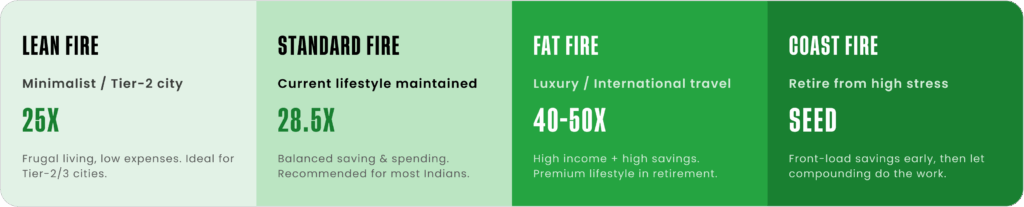
In simple terms, all FIRE followers seek financial freedom, but not everyone pursuing financial freedom wants to retire early.
In 2026, the “Retire Early” (RE) part of FIRE is evolving. For many Indian professionals, it no longer means stopping work completely. Instead, reaching your FIRE number in India 2026 often means gaining the freedom to choose how you work, whether that’s starting a business, consulting, teaching, or working on your own terms.
Frequently Asked Questions (FAQs)
Financial freedom is when your passive investments cover your lifestyle costs forever. To find your number, use the 3.5% India Safe Withdrawal Rate formula: Annual Expenses ÷ 0.035. For example, if you spend ₹12 Lakhs annually, you need a corpus of ≈₹3.43 Crore. This ensures your wealth survives India’s inflation without you ever needing to work again.
The 4% rule suggests you can withdraw 4% of your investment corpus every year without running out of your savings. However, for 2026, experts recommend the 3.5% India Safe Withdrawal Rate. This accounts for India’s higher 5–6% CPI inflation and market volatility. By withdrawing only 3.5%, you ensure your corpus grows enough to maintain your purchasing power over a 30-year period.
It depends entirely on your monthly expenses. While ₹1 Crore is a great milestone, it only generates approximately ₹29,000 per month under the 3.5% India Safe Withdrawal Rate.
You can calculate your financial independence (FI) number in three simple steps.
First, calculate your total monthly expenses and multiply by 12 to get annual spending.
Second, apply the 25x rule by multiplying annual expenses for your “base number”. Or for more accuracy, divide annual expenses by 0.035 using the 3.5% India Safe Withdrawal Rate.
For example, for an annual spend of ₹6 Lakhs, the calculation is ₹6,00,000 × 28.5, which equals a 2026 target of ₹1.71 Crore.
Financial freedom depends more on how much you spend and save, not just your salary. Someone earning ₹15 lakh a year but saving 40% could reach financial independence faster than someone earning ₹40 lakh and spending most of it. The key factors are expenses, savings rate, and investment growth, not income alone.
Click on the Edit Content button to edit/add the content.
Financial freedom is when your passive investments cover your lifestyle costs forever. To find your number, use the 3.5% India Safe Withdrawal Rate formula: Annual Expenses ÷ 0.035. For example, if you spend ₹12 Lakhs annually, you need a corpus of ≈₹3.43 Crore. This ensures your wealth survives India’s inflation without you ever needing to work again.
The 4% rule suggests you can withdraw 4% of your investment corpus every year without running out of your savings. However, for 2026, experts recommend the 3.5% India Safe Withdrawal Rate. This accounts for India’s higher 5–6% CPI inflation and market volatility. By withdrawing only 3.5%, you ensure your corpus grows enough to maintain your purchasing power over a 30-year period.
It depends entirely on your monthly expenses. While ₹1 Crore is a great milestone, it only generates approximately ₹29,000 per month under the 3.5% India Safe Withdrawal Rate.
You can calculate your financial independence (FI) number in three simple steps.
First, calculate your total monthly expenses and multiply by 12 to get annual spending.
Second, apply the 25x rule by multiplying annual expenses for your “base number”. Or for more accuracy, divide annual expenses by 0.035 using the 3.5% India Safe Withdrawal Rate.
For example, for an annual spend of ₹6 Lakhs, the calculation is ₹6,00,000 × 28.5, which equals a 2026 target of ₹1.71 Crore.
Financial freedom depends more on how much you spend and save, not just your salary. Someone earning ₹15 lakh a year but saving 40% could reach financial independence faster than someone earning ₹40 lakh and spending most of it. The key factors are expenses, savings rate, and investment growth, not income alone.
Your monthly savings depend on your timeline and a projected 12% annual return from equity mutual funds. To reach a standard urban FI corpus of ≈₹3.43 Crore
Recommended posts



Related Content



Millionaire Mind Intensive is about unlocking your financial freedom and strengthening your relationship with money.
Quick Links
Contact Info
Success Gyan India LLP
S5, Thiru Vi Ka Industrial Estate,
Guindy, Chennai – 600032